
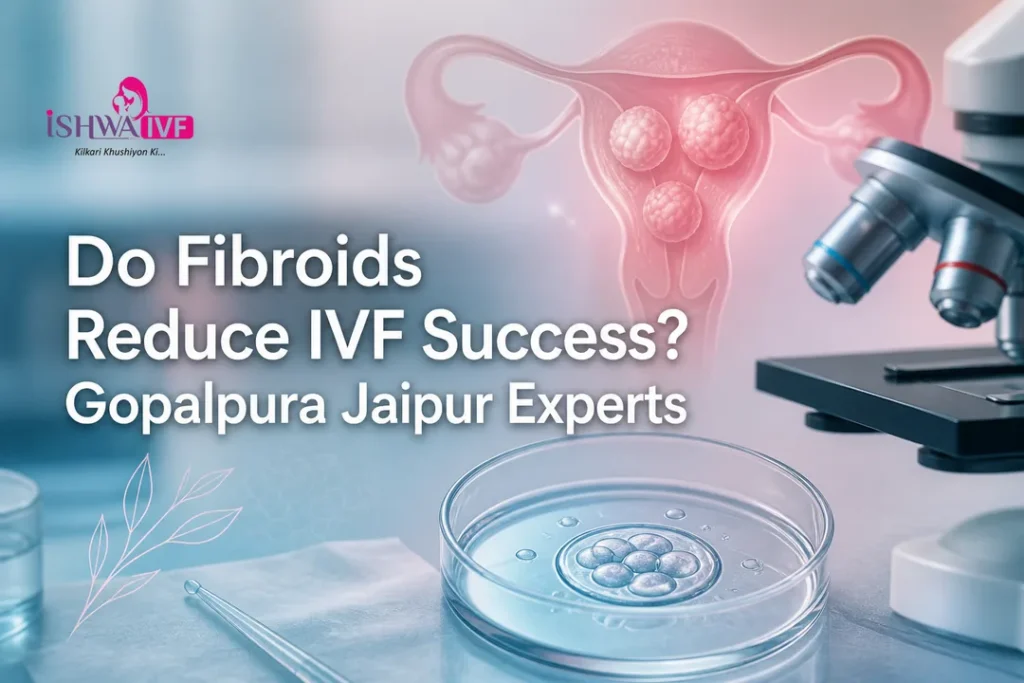
Do Fibroids Reduce IVF Success? Gopalpura Jaipur Experts — this question worries many couples starting treatment. At Ishwa IVF in Gopalpura, we guide you through how fibroids intersect with fertility so you can make confident, timely decisions.
Understanding fibroids and fertility basics
Uterine fibroids are noncancerous growths that can appear in different layers of the uterus: submucosal, intramural, and subserosal. Their effect on conception depends on size, number, and—most importantly—location. Submucosal lesions push into the uterine cavity, intramural grow within the wall, and subserosal project outward.
Fibroids may influence implantation by distorting the cavity, altering blood flow, or triggering local inflammation. They can also contribute to heavy bleeding and anemia, which reduces energy and delays treatment. According to the WHO infertility fact sheet, about one in six people of reproductive age experience infertility at some point, so identifying every reversible factor matters.
For general background on these growths, the MedlinePlus overview of uterine fibroids explains symptoms, typical diagnosis, and treatment options in clear detail. That reliable context helps you separate myths from what truly affects conception.
Do Fibroids Reduce IVF Success? The Evidence
Evidence shows that not all fibroids affect pregnancy rates in the same way. Submucosal fibroids, even when small, can interfere with embryo implantation by disrupting the endometrium. In contrast, subserosal lesions rarely impact outcomes because they sit outside the uterine cavity.
Intramural fibroids live in the uterine wall. When they enlarge enough to indent the cavity or exceed a few centimeters, they may lower chances by hampering blood supply or uterine contractility. However, many small intramural nodules remain harmless. Therefore, we consider the whole picture—your age, ovarian reserve, prior miscarriages, and embryo quality—before recommending surgery.
In practice, our team weighs the trade‑offs with you. Surgery can improve the uterine environment, yet it also adds recovery time and cost. For some patients, starting stimulation and freezing embryos first makes more sense, then addressing the uterus before transfer. For others, a quick hysteroscopic procedure upfront is the shortest path to pregnancy.
How fibroid size and location influence IVF success
Location usually matters more than size. Submucosal growths have the strongest association with poorer implantation. Intramural lesions that distort the cavity sit in the middle, while subserosal growths seldom change outcomes.
Submucosal vs intramural lesions: what matters most
We focus on whether a fibroid touches or deforms the endometrial cavity on imaging. If it does, we discuss removal. If it does not, and your embryos look strong, proceeding without surgery can be reasonable.
- Submucosal: highest risk for implantation issues; hysteroscopic removal often helps.
- Intramural distorting cavity: consider treatment, especially with repeat failures.
- Subserosal: usually observe, as they rarely affect implantation.
- Multiple small nodules: assess cumulative effect, not each fibroid in isolation.
Importantly, results vary by individual biology. Good‑quality blastocysts and a receptive endometrium can still overcome many modest anatomic challenges.
Assessment and timing before treatment
A precise map of your uterus guides the right plan. We start with high‑resolution transvaginal ultrasound. When needed, we add saline infusion sonography (SIS) or 3D ultrasound to evaluate the cavity in detail. If results remain unclear, we may recommend diagnostic hysteroscopy. MRI helps in selected cases with complex anatomy or previous surgeries.
Meanwhile, we evaluate ovarian reserve and male factors so we do not lose time. If you have severe symptoms—heavy bleeding, pelvic pressure, or anemia—we prioritise stabilising your health before ovarian stimulation. That approach improves comfort and safety.
Diagnostic steps we take before treatment
Our workflow keeps your timeline efficient and personalised. Because every month counts, we plan testing and decisions in a single, coordinated pathway.
Hysteroscopy vs ultrasound: when each adds value
Ultrasound supplies a non‑invasive overview and measures fibroids accurately. Hysteroscopy, on the other hand, lets us look inside the cavity and treat small submucosal lesions in the same sitting. We choose the least invasive test that answers the clinical question.
We usually discuss treatment before embryo transfer in these scenarios:
- Any submucosal fibroid confirmed on imaging or hysteroscopy.
- Intramural fibroid that indents the cavity or causes recurrent implantation failure.
- Rapidly growing lesion or persistent heavy bleeding that risks anemia.
- Distorted cavity after prior surgeries or miscarriages.
- Repeated miscarriages with no other clear cause.
When surgery is appropriate, we select the least disruptive option. Hysteroscopic resection removes cavity‑distorting fibroids through the cervix. Laparoscopic or open myomectomy addresses deeper lesions while preserving the uterus. Afterward, we allow the lining to heal before transfer. During that waiting period, many couples freeze embryos so they do not lose reproductive time.
Your path forward: personalised care at Ishwa IVF
In our daily work at Ishwa IVF in Gopalpura, we see a consistent pattern. Submucosal fibroids often sit at the heart of repeated failed transfers. When we treat them, many patients enjoy smoother cycles and improved implantation. At the same time, we also meet couples with small, stable intramural nodules who achieve pregnancy without surgery. Because of that range, we never apply a one‑size‑fits‑all rule.
Our clinic offers the full spectrum of fertility care—IVF, ICSI, IUI, fertility preservation, male infertility evaluation, high‑risk pregnancy care, gynecology, and reproductive endocrinology—so your plan stays seamless from testing to delivery. For a quick overview of who we are, visit Ishwa IVF. We keep your comfort central and explain every decision in plain language.
Access to coordinated, affordable care matters for families across India. The National Health Authority (NHA) highlights how digital health records and system integration improve patient journeys. Likewise, our team organises imaging, surgery, and lab work so you move forward without friction.
Improving IVF outcomes after fibroid treatment
Once we treat a problem fibroid, we focus on healing and optimisation. Typically, we wait for one or two normal cycles after hysteroscopic surgery. After myomectomy, the interval is usually longer to protect the uterine wall; we decide this with you based on surgical details.
Meanwhile, we address modifiable factors so you return stronger:
- Rebuild iron if bleeding caused anemia, and recheck levels before transfer.
- Support the endometrium with evidence‑based protocols tailored to your hormones.
- Plan single‑embryo transfer when embryo quality is high to lower risk.
- Use ICSI, time‑lapse culture, or embryo freezing when indicated by your case.
These steps work together to improve IVF success by aligning embryo quality with a receptive uterine environment. For broader health context, the World Health Organization underscores that equitable access to reproductive care is essential; our practice embraces that principle with transparent counseling.
Above all, we respect nuance. Some patients benefit from swift ovarian stimulation to bank embryos first, especially when age or diminished reserve raises urgency. Others do best with a short surgical detour that prevents multiple failed transfers. We build your roadmap around data, your timeline, and your comfort.
We invite you to meet our specialists, tour our laboratory, and discuss practical next steps at our fertility clinic in Jaipur. You will leave with a clear plan, not a list of confusing options.
Trust builds through clarity. We explain imaging findings with sketches, share photos from hysteroscopy when helpful, and outline probabilities without hype. No single result defines you; your plan adapts as new information appears.
For accurate, patient‑friendly background on fibroids, you can also review the NIH MedlinePlus page. It complements our counseling with well‑vetted education.
In short, fibroids do not automatically block parenthood. Strategic evaluation, selective treatment, and excellent lab practices often overcome the barrier. With compassionate care and modern technology, we help you move steadily toward the family you envision.
Contact Us
Contact Us
Ishwa IVF Clinic
1st Floor, Ganga Heights, Tonk Road
(Near Gopalpura Flyover, Opposite Jaipur Hospital)
Kailash Puri Colony, Jaipur – 302018
📞 Phone: 9351333705