
“I’m Terrified It’s Going to Hurt”
Riya had already been through the hardest part — or so everyone kept telling her.
The injections were done. The egg retrieval was behind her. Three good embryos were waiting safely in the lab. All that remained was the transfer — the moment her doctor would place one of those embryos into her uterus and the real waiting would begin.
But instead of feeling relieved, Riya spent the night before reading horror stories online. Transfer pain. Failed implantation. Bed rest for two weeks. Five different forums giving five completely different answers.
By morning, she was more anxious than she had been at any point in the entire IVF process.
If that sounds familiar — if you are about to go through the embryo transfer procedure in Jaipur and genuinely do not know what to expect — this blog is for you.
No vague reassurances. No clinical language. Just a clear, honest walkthrough of what the procedure involves, what your body typically feels, and what comes next.
What is an Embryo Transfer?
The embryo transfer procedure in Jaipur is the final clinical step in an IVF cycle. After your eggs are retrieved, fertilised in the lab, and developed into embryos over three to five days, the strongest one or two embryos are placed into your uterus through a thin, soft catheter.
No anaesthesia. No incisions. Most women are in and out of the procedure room in under thirty minutes.
The procedure itself is straightforward. What makes it feel significant is everything riding on it — and that is completely understandable.
Fresh Transfer or Frozen Transfer — What Is the Difference?
Before getting into the steps, it helps to know which type of transfer you are having — because the preparation is slightly different for each.
A fresh embryo transfer takes place three to five days after egg retrieval, using embryos developed in that same cycle. A frozen embryo transfer (FET) uses embryos from a previous cycle that were frozen and are now thawed for use. FET cycles have become increasingly common because giving the body time to recover from stimulation often improves the uterine environment before implantation.
Your doctor would have already recommended one based on your hormone levels, embryo quality, and overall cycle response.
How to Prepare for Your Embryo Transfer in Jaipur
The preparation in the days before transfer is specific, and your clinic will walk you through it in detail. Generally it includes:
- Progesterone support — tablets, suppositories, or injections to prepare the uterine lining
- Ultrasound monitoring — to confirm the lining has reached the right thickness, ideally 8mm or above
- A full bladder on the day — this surprises most patients, but a full bladder gently repositions the uterus, making the procedure easier and more precise. Your clinic will ask you to drink water and hold it for about an hour before your appointment
- Normal eating — unlike the retrieval, you do not need to fast for a transfer
Step by Step — What Happens on Transfer Day
When you arrive, a nurse confirms your identity and your embryo details before anything begins. The embryologist prepares your embryo in the lab while you get settled in the procedure room.
The procedure itself starts with you lying on an examination table — same position as a routine gynaecological check. The doctor places a speculum to access the cervix. A thin, flexible catheter is then guided gently through the cervix into the uterine cavity. Most women feel mild pressure at this point, not pain. Some feel almost nothing at all.
The embryo is loaded into the tip of the catheter by the embryologist in a tiny drop of fluid. Under ultrasound guidance, the doctor advances the catheter to the right position inside the uterus and releases the embryo with a gentle push.
The catheter is withdrawn and the embryologist immediately checks it under the microscope to confirm the embryo was released successfully. This takes about sixty seconds.
Then it is over. You rest for around thirty minutes and go home. That is genuinely all there is to it.
Does It Hurt?
For most women — no, not really.
The most common description is that it feels similar to a cervical smear. There is some pressure when the speculum goes in, and occasionally a brief cramping sensation as the catheter passes through the cervix. Women with a narrow cervical opening sometimes find that part slightly uncomfortable, but it passes quickly.
Honestly, the emotional weight of the moment tends to be heavier than any physical discomfort. If you feel tense, tell the nurse. Slow, steady breathing genuinely helps. The procedure moves fast.
How Many Embryos Are Transferred?
In most cases, one to two embryos are transferred depending on your age, embryo quality, and IVF history.
Transferring more embryos does not automatically mean a higher chance of success. It mainly increases the likelihood of twins or multiples, which carries its own set of medical considerations. Your doctor will discuss the exact number with you after reviewing the embryo grading report.
Any remaining good-quality embryos are frozen for future use — so a single retrieval cycle can support multiple attempts if needed.
The Two-Week Wait — What Nobody Warns You About
The embryo transfer procedure in Jaipur takes minutes. What follows is the part most couples find genuinely difficult.
A few things worth knowing during those two weeks:
Light spotting can happen. Implantation bleeding around 6 to 10 days after transfer is normal and does not mean anything has gone wrong.
Cramping is common — and confusing. It can occur both when implantation is happening and when it is not. Do not read too much into it.
Do not stop your medications. Keep taking all prescribed progesterone support until your doctor explicitly tells you otherwise, regardless of how you feel.
Bed rest is not necessary. Lying flat for days has not been shown to improve implantation. Normal, light daily activity is fine. Avoid intense exercise, heavy lifting, and very hot baths — but otherwise, live your normal life.
Test on the day your clinic tells you. Testing too early can give a false result because hCG levels need time to build. Day 14 post-transfer is the standard window.
What Decides Whether the Embryo Implants?
This is what every couple really wants to know — and the honest answer involves some variables that even the best doctors cannot fully control.
Embryo quality matters a great deal. So does the thickness and receptivity of the uterine lining. Age plays a role. And beyond all of that, there is a biological element that medicine has not yet fully cracked.
What a good clinic controls is everything it can — the stimulation protocol, the lab environment, embryo grading, the precision of the transfer itself, and the progesterone support afterwards. Getting all of those right gives the embryo the best possible environment to settle in and grow.
The Embryo Transfer Experience at Ishwa IVF, Jaipur
At Ishwa IVF, Jaipur, the transfer is never treated as just another appointment in the schedule.
The team understands what this particular morning means for the couple involved — and that shapes how every step is handled.
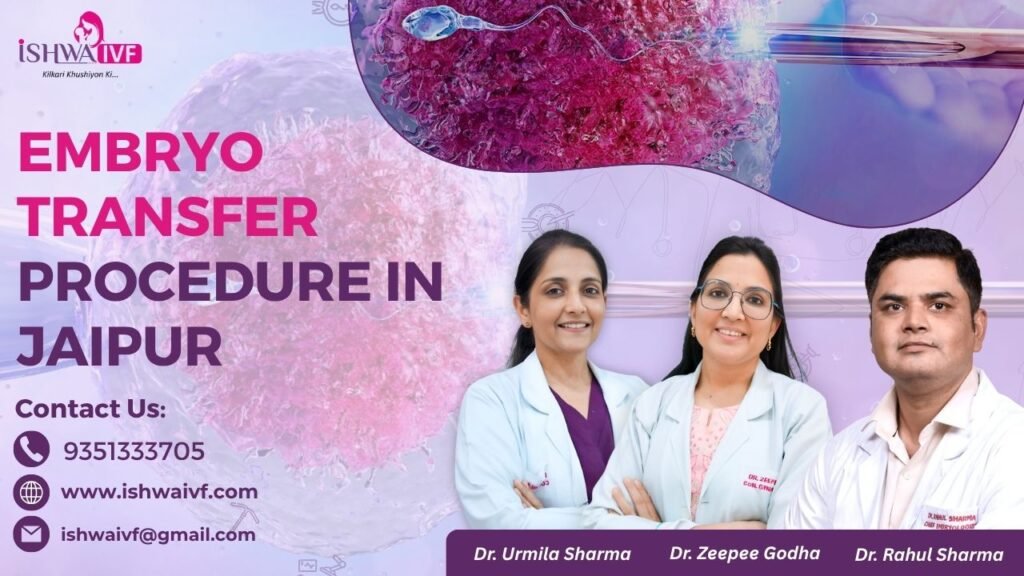
- Dr. Urmila Sharma — Gynaecologist and IVF Specialist who performs the transfer under ultrasound guidance, focusing on precise catheter placement and a calm, comfortable experience for every patient
- Dr. Rahul Sharma — Senior Embryologist who selects and grades each embryo carefully, loads the catheter with precision, and confirms successful release the moment the catheter is withdrawn
- Dr. Zeepee Godha — Gynaecologist, Obstetrician & IVF Specialist with 12+ years of experience and a Fellowship in Clinical Reproductive Medicine from the Indian Fertility Society. Fluent in Hindi and English, she ensures every patient feels fully informed and genuinely cared for at every stage of treatment.
Couples from Kota, Ajmer, Alwar, Sikar, and across Rajasthan travel to Ishwa IVF not because there is no closer option, but because the care here feels different from the first appointment onwards.
It Is a Beginning, Not an Ending
Riya lay on the rest bed after her procedure and realised something.
It had not hurt. There was a moment of pressure, a brief cramp, and then the nurse was already saying “all done.” The whole thing had been over before her anxiety had even settled.
Two weeks later, her test came back positive.
The embryo transfer procedure in Jaipur is not the frightening part of IVF. For most women, it is the quiet part — the morning where everything finally moves from the lab into the place it was always meant to go.
Book Your Consultation at Ishwa IVF, Jaipur
Whether you are preparing for your first embryo transfer or trying again after a previous cycle, the team at Ishwa IVF will walk you through every step clearly and without rush.
Call us today and book your consultation at Ishwa IVF, Jaipur.
Because you deserve to walk into that room feeling ready — not afraid. 💛
Contact Us
Ishwa IVF Clinic
1st Floor, Ganga Heights, Tonk Road
(Near Gopalpura Flyover, Opposite Jaipur Hospital)
Kailash Puri Colony, Jaipur – 302018
📞 Phone: 9351333705