
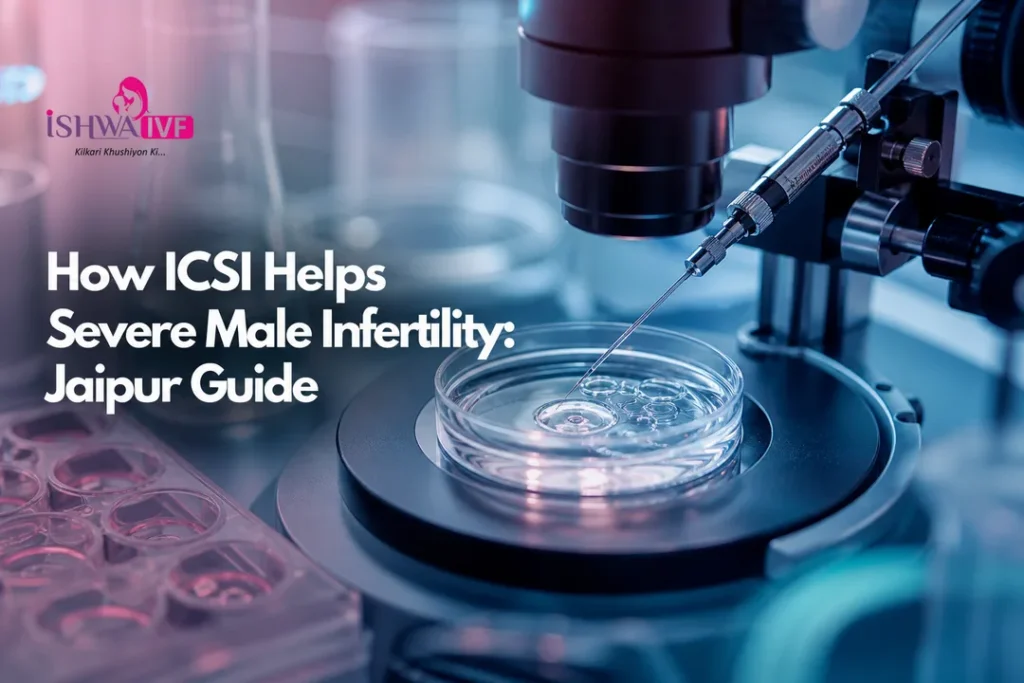
If you or your partner live in Jaipur and face Severe Male Infertility, this guide is for you. How ICSI Helps Severe Male Infertility: Jaipur Guide explains how ICSI teams with IVF to give a fair chance when sperm count, motility, or shape are severely affected.
Why Jaipur Couples Choose ICSI for Tough Cases
Many couples visit our lab after years of trying. They feel hopeful yet cautious. We understand both feelings. In our daily work, we see ICSI help when semen parameters are very poor, after repeated IUI failures, or when a previous IVF cycle showed poor fertilization.
Crucially, Jaipur now offers modern embryology labs with micromanipulators, HEPA-filtered clean rooms, and strict quality control. Because of this setup, ICSI can precisely overcome barriers that standard IVF sometimes cannot. As a result, couples do not need to travel to metro cities for advanced care.
Global data also shows why thoughtful treatment matters. According to the World Health Organization, about one in six adults experience infertility at some point in life. Therefore, you are not alone, and proven tools like ICSI exist to help.
What Is ICSI and When It’s Recommended for Male Factor?
ICSI stands for intracytoplasmic sperm injection. In simple terms, an embryologist selects a single healthy-looking sperm and injects it directly into a mature egg. By bypassing the natural barriers around the egg, ICSI can achieve fertilization even when sperm count is very low or movement is poor.
Doctors recommend it for several scenarios: very low sperm concentration, near-zero motility, severe morphology defects, prior fertilization failure with IVF, use of surgically retrieved sperm (PESA/TESA), and certain cases of unexplained infertility. However, a fertility specialist will match the method to your exact diagnosis.
How ICSI differs from standard IVF
In conventional IVF, thousands of sperm are washed and placed around each egg in a culture dish. Fertilization then happens on its own. By contrast, ICSI uses a microneedle to place one sperm inside one egg under a high-powered microscope. Consequently, ICSI reduces the dependence on natural sperm movement and penetration ability.
Treating Severe Male Infertility: How ICSI Works Step-by-Step
Here is how a typical IVF cycle with ICSI runs at a modern clinic. First, the woman takes ovarian stimulation medicines, while we monitor follicles with scans and blood tests. Next, we collect mature eggs in a short, sedation-based procedure called oocyte retrieval.
Meanwhile, the partner provides a semen sample, or our andrology team performs a surgical retrieval when required. In the ICSI workstation, the embryologist immobilizes a single sperm and injects it into the egg using a micro-pipette. Then we place the eggs in an incubator that carefully controls temperature, humidity, and gas balance.
Fertilization checks happen the next morning. Over the next five days, embryos grow to the blastocyst stage. Finally, we transfer one embryo into the uterus or freeze all for a later, hormonally primed cycle. Throughout, we maintain chain-of-custody checks so each gamete and embryo remains correctly identified.
Results, Risks, Costs, and How to Prepare
ICSI vs IVF for Severe Male Infertility
When semen quality is profoundly impaired, ICSI often delivers higher fertilization rates than standard IVF. For example, if only a few motile sperm exist, IVF may yield no fertilized eggs, while ICSI can still succeed. That said, success depends on egg quality, embryo genetics, the uterine lining, and age. An honest clinic will discuss chances by looking at your reports, not by quoting generic numbers.
Success benchmarks and realistic expectations
Fertilization with ICSI commonly reaches strong rates when eggs are mature and sperm are viable. Nevertheless, fertilization is not pregnancy. Implantation depends on embryo development and the uterus. Importantly, female age remains the single biggest predictor in IVF outcomes. We counsel couples to balance optimism with a clear plan, including backup steps such as embryo freezing.
For safety and policy context, India’s National Health Authority manages the Ayushman Bharat PM-JAY public health insurance program, which defines standards for empanelment and transparency in hospitals (National Health Authority). Meanwhile, the WHO’s reproductive health resources outline the role of assisted reproductive technologies and emphasize quality and patient counseling.
Risks and how clinics reduce them
No medical treatment is risk-free. With ICSI and IVF, the main concerns include ovarian hyperstimulation in the woman, multiple pregnancy if more than one embryo transfers, and rare procedural complications. Reputable clinics lower these risks by using mild stimulation when needed, single-embryo transfer policies, and continuous lab quality audits. We also discuss genetic testing options where appropriate, but we avoid overuse when it does not add value.
Cost, timeline, and a preparation checklist
Budgets vary with medication dose, diagnostic tests, surgical sperm retrieval, freezing, and the number of cycles. A transparent clinic will issue an itemized estimate before you start. Typically, a complete cycle spans six to eight weeks from the first scan to the pregnancy test. Therefore, planning work leave and logistics early reduces stress.
Documents and diagnostics to carry
- All previous reports: semen analysis, hormone profiles, ultrasounds, and treatments tried.
- Medical history for both partners, including allergies and long-term medicines.
- Government ID copies and marriage proofs if needed by local regulations.
- Any lifestyle or occupational exposures relevant to sperm health.
- Questions you want your fertility doctor to answer in the first consult.
Before stimulation starts, we often suggest three to six weeks of targeted lifestyle changes. For instance, stop smoking, limit alcohol, sleep well, and maintain a healthy BMI. In addition, address varicocele or infections if your urologist advises. Small steps compound into better lab results.
Choosing the right clinic in Jaipur
Look for a center that shows its lab, explains its protocols, and reports clear embryo and pregnancy data. Moreover, ensure a senior embryologist performs ICSI in-house. At Ishwa IVF, our team follows strict lab KPIs, including temperature mapping and daily equipment calibration. We encourage you to ask for a walkthrough so you can see quality in action.
Beyond technology, compassionate counseling matters. Couples do better when they understand each phase. Consequently, we hold pre-cycle orientations that cover stimulation plans, male factor nuances, and the differences between IVF, ICSI, and IUI. You can start by speaking with our coordinators at our Jaipur fertility clinic.
FAQs: Practical Answers From Our Embryology Team
Does ICSI fix genetic issues in sperm?
ICSI helps the sperm reach the egg, but it does not cure underlying genetics. Therefore, when family history or severe abnormalities exist, we may suggest genetic counseling. Together, we will discuss options like Y-chromosome microdeletion testing or karyotyping for the male partner.
What if the semen sample shows no sperm on the day?
We plan backup strategies. For example, we can freeze a usable sample in advance. If needed, our urology colleagues perform PESA or TESA on the same day to retrieve sperm. Because the egg retrieval is already scheduled, this preparation avoids cycle cancellation.
Can antioxidants or lifestyle changes replace ICSI?
Healthy habits support sperm function, and we recommend them. However, when lab parameters are profoundly low, lifestyle alone may not overcome the barrier to fertilization. In such cases, ICSI provides a direct route to the egg while you continue long-term improvements.
How many embryos should we transfer?
We advocate for single-embryo transfer in most cases, especially for younger women or when embryo quality is good. This approach keeps risks lower without compromising cumulative success when additional embryos remain frozen. Ultimately, the plan is individualized after reviewing your embryo development.
Our First-Hand Perspective: What We See in the Lab
Across hundreds of cycles, we notice a consistent pattern. When sperm motility is near zero or morphology is severely abnormal, ICSI often turns a “no-fertilization” risk into a realistic chance. We also notice that calm, well-briefed couples handle delays and decisions better. Therefore, we dedicate time to pre-cycle education and written plans.
Another learning is the value of staged choices. For instance, we sometimes freeze all embryos and transfer in a later cycle when the uterine lining looks ideal. Because timing matters, that small decision can lift the overall pregnancy chance without changing the embryo itself.
Takeaway and Next Steps
For many couples, Severe Male Infertility does not have to end the dream of parenthood. With careful diagnosis and a high-quality lab, ICSI within an IVF cycle can unlock fertilization even when counts or motility are critically low. However, outcomes vary by age, egg quality, underlying health, and adherence to a well-structured plan. If you want a transparent, step-by-step discussion, our team in Jaipur is ready to help you compare options and map out a clear path.
Contact Us
Ishwa IVF Clinic
1st Floor, Ganga Heights, Tonk Road
(Near Gopalpura Flyover, Opposite Jaipur Hospital)
Kailash Puri Colony, Jaipur – 302018
📞 Phone: 9351333705