Female Infertility Tests Before IVF: HSG, AMH, Ultrasound


Written and medically reviewed by
Dr. Urmila Sharma and Dr. Zeepee Godha
8 min read
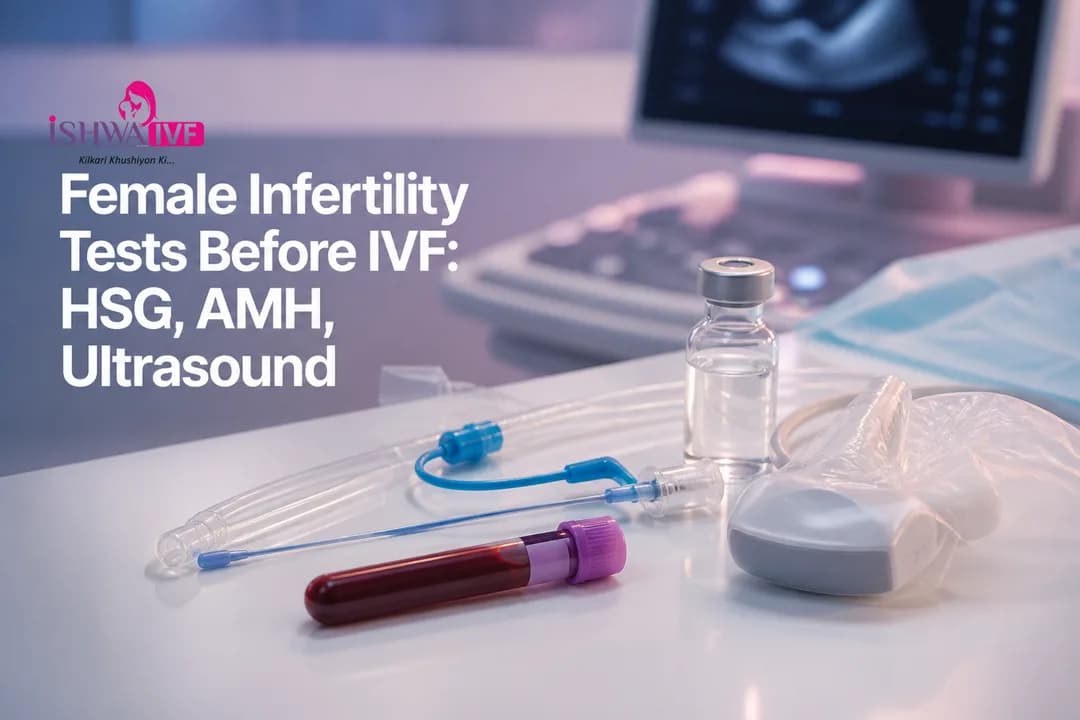
If you are searching for clarity before starting IVF, the right evaluation can save time and reduce stress. In this guide, Female Infertility Tests Before IVF: HSG, AMH, Ultrasound explains what each test checks, what the results can mean, and how fertility specialists use them to plan a safer, more personalised fertility treatment. Importantly, these tests do not “judge” you. Instead, they map the uterus, tubes, and ovaries so your care team can choose between options like IUI, ICSI, or an IVF protocol that fits your body.
Why Testing Matters Before Starting IVF
First, testing helps your fertility doctor identify the likely cause of female infertility. That information guides the treatment path. Sometimes the best first step is ovulation support or IUI. In other cases, IVF gives the best chance because of tubal factors, endometriosis, or age-related ovarian reserve decline.
Moreover, good pre-IVF testing prevents avoidable cycle cancellations. For example, if a scan suggests a cavity issue, your specialist can treat it before stimulation. As a result, embryo transfer happens in a more receptive uterus.
In our work at Ishwa IVF, we often see couples arrive after months of scattered tests from different places. However, once we organise them in a single plan, the picture becomes clear. That clarity supports smarter decisions about timing, protocol choice, and whether to consider egg freezing or embryo freezing.
A Practical Checklist You Can Use at Your First Visit
Next, it helps to know what questions these tests answer. Bring any prior reports and ask what still needs repeating. Importantly, labs can vary, so your fertility specialist may prefer a consistent testing baseline.
- Ovarian reserve: Do you likely have enough recruitable follicles for stimulation?
- Uterus and lining: Is the cavity suitable for implantation?
- Fallopian tubes: Are they open, blocked, or dilated?
- Ovulation pattern: Do you ovulate regularly, or is PCOS likely?
- General reproductive health: Are thyroid or prolactin issues affecting cycles?
Finally, remember that results need context. A single number rarely decides an IVF plan. Instead, your age, scan findings, and history shape the next steps.
Female Infertility Tests Before IVF: What Each One Shows
Before stimulation begins, clinics focus on three core tools: HSG, AMH, and ultrasound. Together, they show tubal patency, ovarian reserve, and uterine structure. Therefore, they sit at the heart of most infertility treatment workups.
HSG (Hysterosalpingography): Checking the Tubes and Uterine Shape
An HSG is an X-ray procedure that uses contrast dye to assess whether the fallopian tubes are open. It also outlines the uterine cavity. Consequently, it can detect issues like tubal blockage or an abnormal cavity shape.
Typically, the test happens after your period ends and before ovulation. Your team schedules it in that window to avoid pregnancy risk and to get a clearer view. Although many women feel cramping, the discomfort is usually short. Your doctor may recommend pain relief beforehand.
Importantly, tubal disease plays a significant role in infertility globally. The World Health Organization (WHO) infertility fact sheet notes that infertility can result from tubal factors among other causes. Because of that, an HSG often becomes a key step before IVF or IUI decisions.
When HSG Results Change the IVF Plan
For example, an HSG may show a hydrosalpinx, which is a dilated tube with fluid. In that case, your fertility specialist may discuss treating the tube before embryo transfer. That discussion matters because tubal fluid can reduce implantation chances in some patients.
On the other hand, if the tubes look open and the uterine outline looks normal, your doctor may consider less invasive options first. However, age, sperm factors, and time trying still influence that choice.
AMH (Anti-Mullerian Hormone): Estimating Ovarian Reserve
AMH is a blood test that helps estimate ovarian reserve. In simple terms, it reflects the pool of small follicles in the ovaries. Therefore, it helps your team predict how your ovaries may respond to stimulation medicines used in IVF and ICSI cycles.
Unlike some hormones, AMH stays relatively stable throughout the menstrual cycle. As a result, many clinics can test it on most days. Still, your fertility clinic may pair it with other labs for a complete view.
Importantly, AMH does not measure egg quality directly. Age remains the strongest proxy for egg quality in routine care. So, a person can have a “normal” AMH and still face age-related egg quality decline. Similarly, someone can have a lower AMH and still conceive with tailored stimulation or with options like embryo freezing at an earlier stage.
For deeper background, the U.S. National Library of Medicine offers clear patient-facing explanations on reproductive hormones and testing through MedlinePlus AMH testing. This aligns with how many fertility doctors interpret AMH as one part of ovarian reserve assessment.
Female Infertility Tests Before IVF: Ultrasound and AFC Explained
Ultrasound completes the picture because it shows structure in real time. Most clinics use transvaginal ultrasound for the clearest view. Importantly, the scan does not only “look for cysts.” It supports decisions about protocol, timing, and endometrial preparation for embryo transfer.
Baseline Transvaginal Ultrasound: Uterus, Ovaries, and Lining
First, a baseline scan checks the uterus and ovaries early in the cycle. Your doctor measures the endometrium, looks for polyps or fibroids, and checks for ovarian cysts. Next, the same scan estimates follicle count and ovarian volume.
In practice, this is where we spot issues that can delay IVF for the right reasons. For instance, a polyp can interfere with implantation. Similarly, a large cyst can affect hormone levels and response to medicines. Therefore, correcting the issue first often leads to a smoother cycle.
Additionally, ultrasound supports pregnancy care after treatment. Once conception occurs, early scans confirm location and viability. If you have risk factors, your team can coordinate high risk pregnancy monitoring as needed.
Antral Follicle Count (AFC): A Key Partner to AMH
AFC counts the small resting follicles visible on ultrasound, usually early in the cycle. It complements AMH. Consequently, doctors rely on both to estimate stimulation response and medication dosing.
Notably, AFC also helps reduce the risk of ovarian hyperstimulation syndrome (OHSS). If the ovaries show a very high follicle count, the clinic may adjust the protocol. That adjustment can include different trigger shots or a freeze-all approach with embryo freezing.
How Specialists Use These Results to Build Your Treatment Plan
Once HSG, AMH, and ultrasound results are in, the goal becomes decision-making. Therefore, your fertility specialist will translate medical findings into a clear plan. That plan may include IVF, ICSI for severe male infertility factors, or IUI when tubes are open and sperm parameters allow.
In addition, your doctor may recommend supportive tests based on history. For example, thyroid and prolactin tests can explain irregular ovulation. Similarly, an infection screen can protect pregnancy outcomes and clinic safety.
Importantly, no test offers certainty. Results vary depending on age, diagnosis, and how long infertility has lasted. Moreover, even “normal” reports do not rule out endometriosis or subtle egg quality issues. Because of this, the best IVF center will explain the trade-offs and set realistic expectations about IVF success rates.
Choosing Between IVF, IUI, and ICSI Based on Findings
First, tubal blockage on HSG often pushes care toward IVF. That is because IVF bypasses the tubes. In contrast, open tubes and mild ovulatory issues may support a trial of IUI, especially when time allows.
Next, ovarian reserve results guide intensity. If AMH and AFC suggest lower reserve, your doctor may recommend moving faster to IVF rather than repeating low-yield cycles. On the other hand, a high AFC pattern can suggest PCOS, where careful dosing reduces OHSS risk.
Finally, semen results matter too, even in a “female testing” conversation. If sperm parameters show severe issues, ICSI often improves fertilisation rates. That is why many fertility clinics evaluate both partners early.
Preparing for Your Tests and Reducing Anxiety
Testing can feel overwhelming. However, a few practical steps can make it easier. Bring prior reports, list your cycle dates, and share any symptoms like painful periods, heavy bleeding, or prior pelvic infections.
Similarly, ask your clinic what to expect on the day. For HSG, you may want to plan a lighter schedule afterward. For ultrasound, a full bladder is usually not required for transvaginal scanning. For AMH, you can often test any day, which helps if you travel or work long hours.
Furthermore, choose a fertility clinic that explains results in plain language. A strong team will also discuss fertility preservation options like egg freezing when timing matters. If you want to explore services, you can start with Ishwa IVF and note down questions for your appointment.
Meanwhile, keep your focus on controllable steps. Good sleep, stable blood sugar, and stress management will not “fix” infertility. Still, they support smoother treatment and recovery. For broader reproductive health guidance, you can also refer to the National Health Authority for India-focused health program information.
In short, the goal of Female Infertility Tests Before IVF: HSG, AMH, Ultrasound is simple. It helps you move into IVF with fewer unknowns and more confidence. When you review results with a fertility doctor, you build a plan that fits your diagnosis, timeline, and comfort level.
Contact Us
Ishwa IVF Clinic
1st Floor, Ganga Heights, Tonk Road
(Near Gopalpura Flyover, Opposite Jaipur Hospital)
Kailash Puri Colony, Jaipur – 302018
📞 Phone: 9351333705
At Ishwa IVF, our team works hands-on with infertility treatment planning every day, from first tests to embryo transfer and pregnancy care. If you want a calm, transparent review of your reports, you can reach out through our fertility clinic team for next-step guidance.
Written and medically reviewed by Dr. Urmila Sharma and Dr. Zeepee Godha. This article is general information and does not replace a consultation. Your doctor will advise you on your own situation.