IVF Add-Ons Evidence: ERA, Scratching, PRP Guide


Written and medically reviewed by
Dr. Urmila Sharma and Dr. Zeepee Godha
7 min read
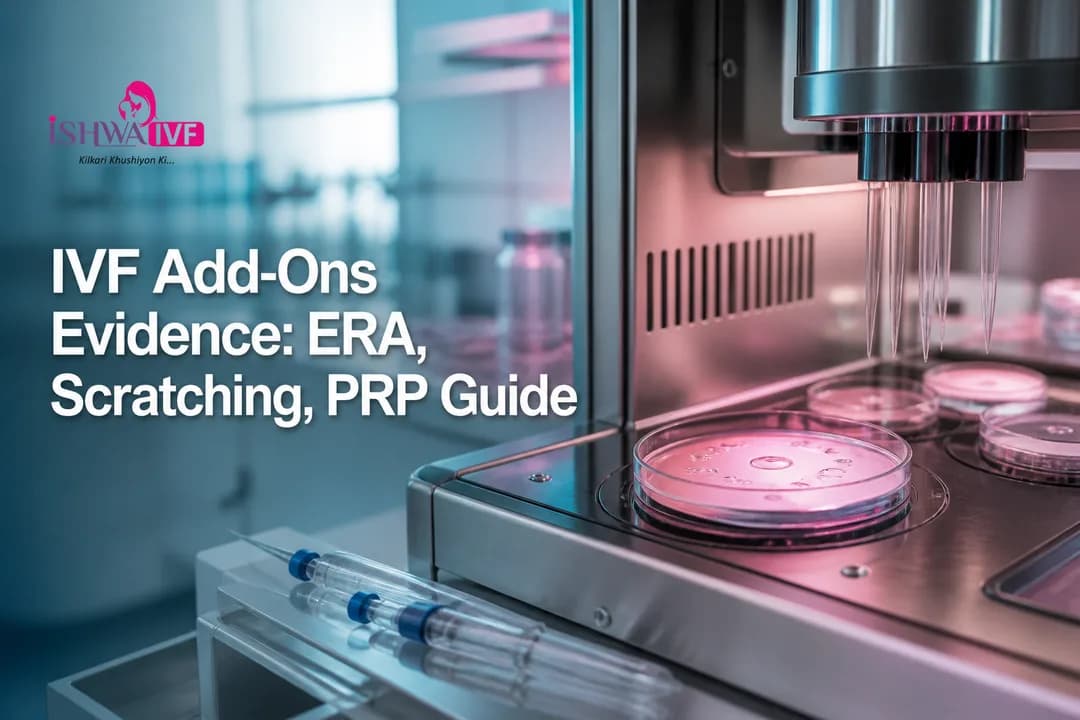
If you are searching for IVF clarity, the title says it all: IVF Add-Ons Evidence: ERA, Scratching, PRP, Do They Help? Many couples feel pressured to add “extras” to a cycle. However, not every add-on improves outcomes. In this guide, we explain what the evidence says, who might benefit, and what to ask your fertility specialist.
Why IVF Add-Ons Feel Tempting (And Why Evidence Matters)
First, IVF can feel like a high-stakes timeline. So, it is normal to want to “do everything” in one attempt. As a result, add-ons often sound like an insurance policy for implantation.
However, helpful care means matching the right test or procedure to the right problem. In fertility treatment, more interventions can also mean more cost, more steps, and more uncertainty. Therefore, evidence matters as much as hope.
In our work at Ishwa IVF, we often meet couples after a failed embryo transfer. Notably, many have already tried extra procedures without a clear reason. When we review reports, we usually find a simpler gap, such as embryo quality, uterine cavity issues, thyroid control, or timing decisions.
IVF Add-Ons Evidence: What Research Trends Suggest
Importantly, different add-ons have different levels of support. Some help only in narrow scenarios. Others remain unproven for routine use. Therefore, your fertility doctor should explain the “why” for your case.
In general, high-quality evidence comes from well-designed randomized trials and large systematic reviews. In contrast, small studies and clinic-to-clinic success stories can overestimate benefits. So, you should ask whether an add-on is supported by strong trials or mainly by limited data.
When you see claims about improved IVF success rates, ask one more question. Does the evidence show higher live birth rates, or only better intermediate markers. For example, a thicker lining does not always mean higher pregnancy outcomes.
How To Judge An Add-On Before You Pay
First, ask what problem the add-on targets. Next, ask what alternatives exist. Finally, ask what the downsides are, including discomfort, cycle delay, or false reassurance.
- Indication: What diagnosis or pattern makes this useful for me?
- Outcome: Does it improve live birth, or only implantation markers?
- Evidence: Is support based on large trials or small studies?
- Trade-offs: Will it delay transfer or increase medication burden?
- Plan B: If it fails, what is the next step in infertility treatment?
A Quick Note On Safety And Standards
Importantly, quality control matters. Any procedure that involves uterine instrumentation or lab handling should follow strict infection prevention and traceability practices. In addition, clinics should explain consent, risks, and expected discomfort in plain language.
ERA, Scratching, PRP: What Each Add-On Really Does
Now let’s break down three common add-ons you may hear about during IVF or ICSI planning. We will focus on what the test or procedure aims to change, and what the evidence trend looks like.
ERA (Endometrial Receptivity Analysis): Timing The “Window”
ERA is a test that evaluates gene-expression patterns in an endometrial biopsy. In simple terms, it aims to identify when your uterus is most receptive. Therefore, it may suggest a personalised progesterone exposure time for frozen embryo transfer cycles.
However, evidence does not support ERA for routine use in all patients. In fact, a large randomized clinical trial published in JAMA found that an endometrial receptivity test did not improve live birth rates compared with standard timing in women undergoing frozen euploid embryo transfer. You can review the trial record and details through PubMed research listings on endometrial receptivity testing.
That said, some clinicians still consider it in select scenarios. For example, it may be discussed after repeated implantation failure when embryo factors and the uterine cavity have been carefully assessed. Even then, results vary, and you should weigh the cost and biopsy step.
Endometrial Scratching: A “Reset” Theory Under Question
Endometrial scratching refers to deliberately creating a small injury to the uterine lining, often in the cycle before embryo transfer. The idea is that healing may change local inflammatory signals and improve implantation.
However, larger studies and reviews have not shown consistent benefit for most patients. Therefore, many guidelines discourage routine scratching. In addition, scratching can cause pain and spotting, and it can also add procedural anxiety.
Still, context matters. If a patient already needs a hysteroscopy for suspected polyps or adhesions, a doctor may focus on correcting the cavity rather than adding scratching. Consequently, the “real” benefit often comes from diagnosing and treating uterine pathology, not from injury itself.
PRP (Platelet-Rich Plasma): Healing Signals, Limited Proof
PRP uses a concentrated portion of a patient’s own blood platelets. Clinics may place PRP into the uterus for thin lining concerns, or they may discuss ovarian PRP in low ovarian reserve situations. Because PRP contains growth factors, the aim is to support tissue response.
However, strong evidence remains limited, and protocols vary widely. As a result, results can look different between fertility clinics. Therefore, you should treat PRP as an option under evaluation, not a guaranteed booster.
In practice, when we discuss PRP for thin endometrium, we first confirm the basics. For instance, we check cavity shape, rule out chronic endometritis when indicated, review estrogen response, and assess blood flow. Then, if we still see a persistently thin lining, we may discuss PRP as one part of a broader plan.
Who Might Benefit And Who Should Pause First
Notably, “add-on” decisions should follow a stepwise infertility evaluation. Otherwise, you may miss higher-impact changes. Therefore, a good IVF center will start with fundamentals and add complexity only when it has a clear purpose.
First, ask whether the embryo factor has been addressed. For example, if sperm parameters suggest severe male infertility, then ICSI may matter more than any uterine add-on. Similarly, if there is a history of miscarriage, your doctor may prioritise uterine assessment, thyroid control, and genetic considerations.
Second, confirm uterine readiness. Many implantation problems come from issues like polyps, fibroids that distort the cavity, adhesions, or unrecognised infection or inflammation. Because of this, targeted gynecology evaluation can outperform broad add-ons.
A Practical “Before Add-Ons” Checklist
First, clarify what has already been optimised. Next, ensure your plan reflects your diagnosis. Finally, confirm which outcome the add-on is expected to improve.
- Review embryo stage and grading, and discuss blastocyst culture when relevant.
- Check uterine cavity with ultrasound, and consider hysteroscopy if indicated.
- Optimise thyroid, prolactin, vitamin status, and metabolic health where appropriate.
- Address sperm DNA or severe male factor if suggested by testing.
- Plan transfer timing and progesterone support with clear monitoring milestones.
Importantly, add-ons do not replace core medical optimisation. So, think of them as “targeted tools,” not universal upgrades. This approach also supports patient safety and budget planning.
How We Counsel Couples At Ishwa IVF Before Adding Extras
At Ishwa IVF, we try to make every step feel understandable. So, we explain what we know, what we do not know, and what we will measure next. In addition, we document why an intervention fits your clinical story.
For example, if a couple comes after a failed IVF cycle, we start with a structured review. First, we look at stimulation response, egg maturity, and fertilisation. Next, we review embryo development and transfer details. Then, we check uterine findings, lining, and hormone support. Only after that do we discuss optional add-ons.
Moreover, we encourage couples to use questions as a decision tool. If the team cannot explain a mechanism, a benefit, and a downside, you should pause. You can also explore our approach to compassionate care at Ishwa IVF.
Importantly, fertility care should align with recognised health guidance and safe medical practice. For broader reproductive health context, you can read patient-friendly resources from the World Health Organization. In India, you can also explore healthcare system resources via the National Health Authority.
In short, the best plan feels personalised, not overloaded. Therefore, we aim for decisions that improve clarity and reduce regret.
Ultimately, IVF Add-Ons Evidence: ERA, Scratching, PRP, Do They Help? has a careful answer. Some add-ons may help in specific cases, while many do not improve live birth rates for routine patients. Because results vary by diagnosis, embryo quality, age, and uterine factors, your fertility specialist should guide you with transparent evidence and realistic expectations. If you want a second opinion or a structured plan that fits your situation, you can connect with our fertility clinic team for a calm, non-pushy discussion.
Contact Us
Ishwa IVF Clinic
1st Floor, Ganga Heights, Tonk Road
(Near Gopalpura Flyover, Opposite Jaipur Hospital)
Kailash Puri Colony, Jaipur – 302018
📞 Phone: 9351333705
As a dedicated IVF center, we help patients navigate options with evidence-led counselling and hands-on clinical experience, so you can choose what truly supports your path to parenthood.
Written and medically reviewed by Dr. Urmila Sharma and Dr. Zeepee Godha. This article is general information and does not replace a consultation. Your doctor will advise you on your own situation.